Integrating Apple Intelligence in SwiftUI Applications
A complete and developer friendly explanation of Apple Intelligence, how it works, the devices that support it, and how it integrates with SwiftUI applications.
Integrating Apple Intelligence in SwiftUI Applications
Apple Intelligence introduces a new experience across the Apple ecosystem by combining private on device generative capabilities with deep system integration. It brings rewriting tools, improved natural language understanding, image generation, and personal context awareness directly into the operating system. SwiftUI developers can take advantage of these tools without managing external models or storing user data. This post explains what Apple Intelligence is, the supported devices, and how it fits into SwiftUI based applications.
1. What Is Apple Intelligence
Apple Intelligence is Apple’s personal intelligence system that enhances the user experience through natural language understanding, generative capabilities, and contextual awareness. It is powered by a set of large language models specifically optimized by Apple for on device execution. These models enable rewriting, summarization, interpretation, and short form reasoning while maintaining strong privacy protections.
Developers interact with these capabilities through the Foundation Models framework. When working with Apple Intelligence inside Swift, developers import import FoundationModels, which exposes system level models and APIs that plug into SwiftUI or UIKit with minimal setup. Apple provides a small on device model that executes privately using the Neural Engine inside Apple Silicon chips. This model handles everyday tasks such as rewriting, short summaries, tone changes, and lightweight generation.
For more advanced or creative tasks, Apple Intelligence can invoke a larger model through Private Cloud Compute. This larger model runs on custom Apple Silicon servers designed with verifiable privacy guarantees. User requests are processed inside temporary runtime environments that do not store logs or identifiers. The system automatically chooses whether to use the on device model or the cloud backed model depending on the complexity of the task.
Apple Intelligence also interprets personal context such as notes, messages, calendar events, and on screen content. This enables the system to deliver more relevant suggestions and natural interactions. Apps never receive this private information. Instead, developers benefit indirectly through improved writing tools, more reliable Siri understanding, and better natural language mapping for App Intents.
Writing Tools, Image Playground, Genmoji, and enhanced Siri interactions appear throughout the system. SwiftUI developers embed these features through system provided components that look and behave consistently across Apple platforms.
2. Supported Devices and Chips
Apple Intelligence is limited to devices that meet specific hardware and memory requirements. Instead of listing every model here, you can view the official and continuously updated list of supported iPhones, iPads, and Macs directly from Apple. The full compatibility list is available at https://support.apple.com/en-jo/121115.
3. Using Apple Intelligence in SwiftUI Applications
This section presents a small and simple proof of concept that demonstrates how Apple Intelligence can be introduced into a SwiftUI application. It is meant as an easy starting point that helps developers understand the basic structure of integrating writing tools, image generation, Genmoji, or enhanced Siri interactions. You can expand this example further, experiment with different system components, and build more advanced experiences.
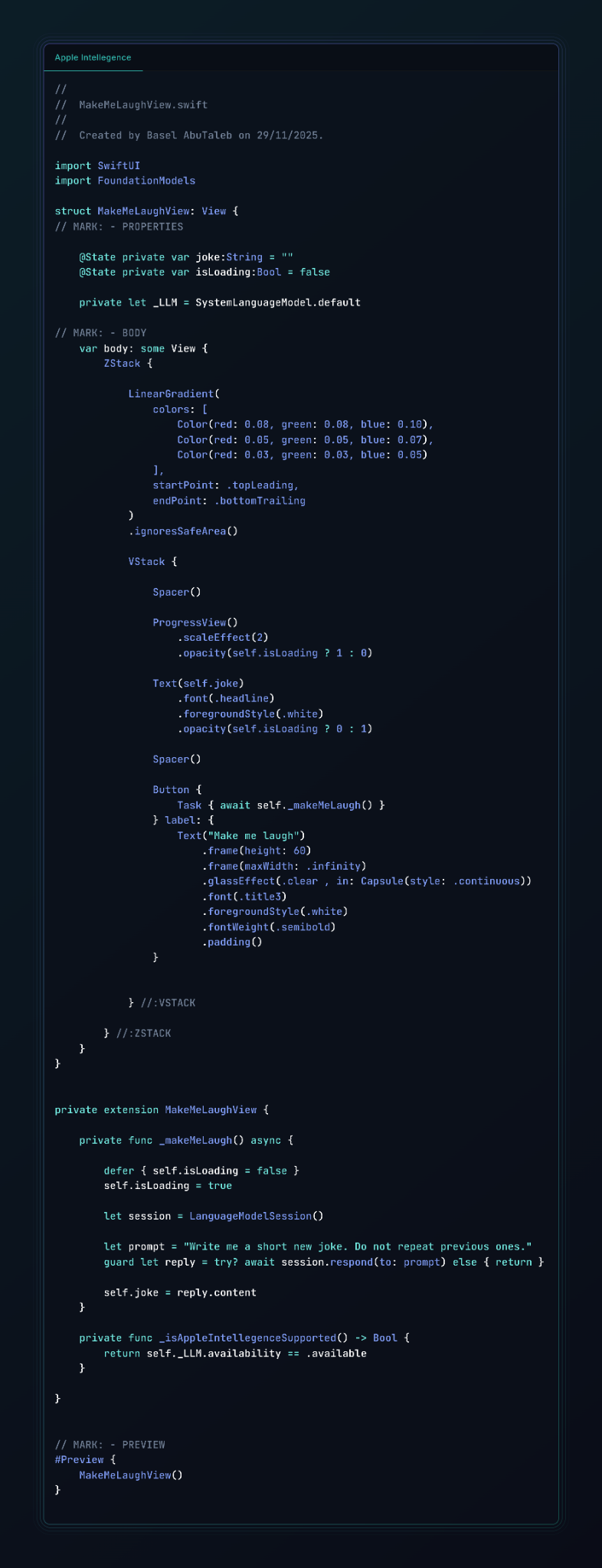
The example shown below uses the system language model to generate a short joke on demand. A new LanguageModelSession() is created with each request to encourage variety and reduce repeated responses. You can dive deeper into Foundation Models by exploring the official documentation at https://developer.apple.com/documentation/foundationmodels.
Implementation Code
Conclusion
Apple Intelligence delivers a powerful and privacy focused intelligence layer to Apple platforms. It enhances writing experiences, image creation, and voice interactions while protecting user data. SwiftUI developers can integrate these features with minimal effort through system provided components. As Apple expands the capabilities and availability of Apple Intelligence, it will become an essential part of modern app development across the ecosystem.